Retaining Wall Construction in Queen Creek, AZ
Queen Creek is mostly flat farm ground, so most retaining walls here hold a grade difference between lots, a raised pool deck, or the edge of a drainage swale. The Town has specific rules for each of those.
Get a Free QuoteA Retaining Wall Is Not a Fence in Queen Creek
The Town's Zoning Ordinance draws a clear line. A "fence" is any manmade barrier, walls included, but not retaining walls. A retaining wall is its own thing: a barrier built to stabilize soil, slow erosion, or terrace a site. That distinction decides which rules apply and what drawings the Building Division expects.
It also explains a gap many homeowners run into. The Town publishes four standard details that let a homeowner skip the engineer on an ordinary block fence. All four are free-standing fence walls. None is a retaining wall, and the Town's other path is engineered drawings for concrete masonry construction. In practice, budget for an engineer on anything that holds back soil, and confirm the specifics with the Building Division at 480-358-3003.
The 6 Foot and 8 Foot Rule on Uneven Lots
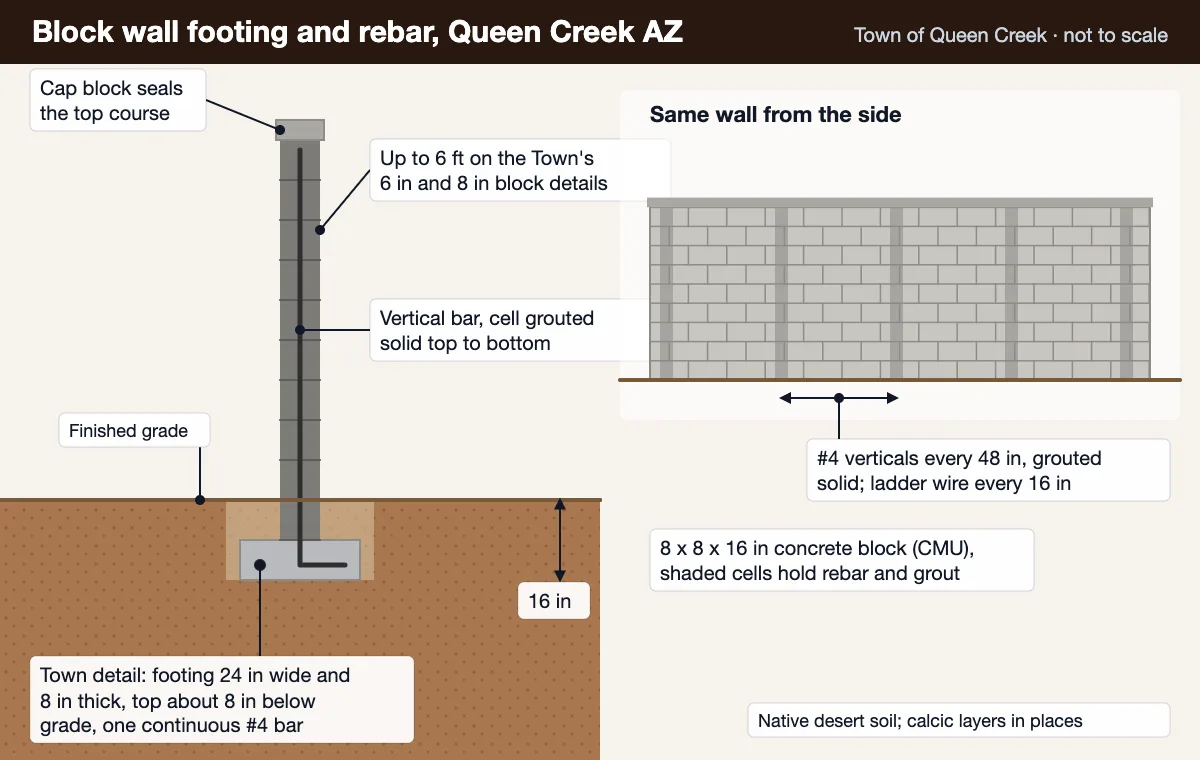
When a privacy wall sits on top of a retaining wall, or when a property line wall separates two pads at different heights, Section 5.2 measures it twice. From the high side it may be no taller than 6 feet above the highest finished grade. From the low side it may never exceed 8 feet. If the low side reads more than 6 feet, the part above 6 feet has to be view fencing (the ordinance gives the example of 6 feet solid with 2 feet of view on top), and the difference has to be softened with berming, landscaping or offsets.
Any fence above 6 feet must be designed by an Arizona registered structural engineer and approved by the Town. So a combined retaining and screen wall that ends up 7 feet tall on the neighbor's side is an engineered project twice over: once for the soil it holds, and once for its height.
Where Retaining Walls Show Up in Queen Creek
Where one pad sits higher than the next, the shared wall holds back soil on one side. This is the situation Section 5.2 addresses with its 6-foot and 8-foot measurement rule.
Flat Queen Creek lots still get raised when a pool, sport court or patio is added. Short walls that hold fill around those pads are retaining walls even when they look like garden borders.
Walls along swales and retention areas manage monsoon runoff. Their footings need protection from scour and their weep openings must stay clear.
The few genuinely sloped parcels sit toward the San Tan Mountains on the south side, where the soil survey maps rock outcrop and gravelly soils on 20 to 65 percent slopes. Those sites need site-specific engineering.
Grading Rules and Steep Slopes
The Zoning Ordinance's grading section says slopes steeper than three to one, where plants alone will not hold the soil, must be held with retaining walls, rip-rap or groundcover, or terraced with diversions to control runoff. For a homeowner that usually means a berm or swale steeper than 3:1 is a candidate for a short wall rather than more gravel.
Outside an approved subdivision, the Town's fence and wall submittal checklist asks for existing and proposed topography with drainage arrows. Inside a platted subdivision the grading plan already exists, and a new wall should not undo it. A retaining wall that blocks a swale the builder designed can send water toward a house.
Soil and Drainage Behind the Wall
Across most of town the USDA soil survey maps sandy and loamy stream deposits: Gilman loam around Town Hall, Vint loamy fine sand in parts of the northwest, and Antho sandy loams toward the southern edge. These drain well, which helps behind a wall, but they also wash out easily if water is allowed to pour over the top or around the ends. Pockets of Contine clay loam, a heavier clay soil the survey classifies as vertic (prone to shrink and swell), show up toward the northeast corner and push harder on a wall when wet.
Queen Creek averages roughly 8 inches of rain a year, much of it in short monsoon bursts. A sound retaining wall here has free-draining gravel behind it, a way out for that water at the base, and a top that sheds runoff rather than collecting it. Ask any engineer or contractor to show those three things on the drawing.
Outside Town Limits
Unincorporated Maricopa County parcels near Queen Creek follow the county's bulletin instead: a zoning clearance for retaining walls over 18 inches, sealed plans over 4 feet, and a 6-foot maximum height. Check which side of the town line you are on before drawing anything.
Permit Guide →Retaining walls in Queen Creek, drawn around the Town's grade and height rules.
Get a Free Estimate